
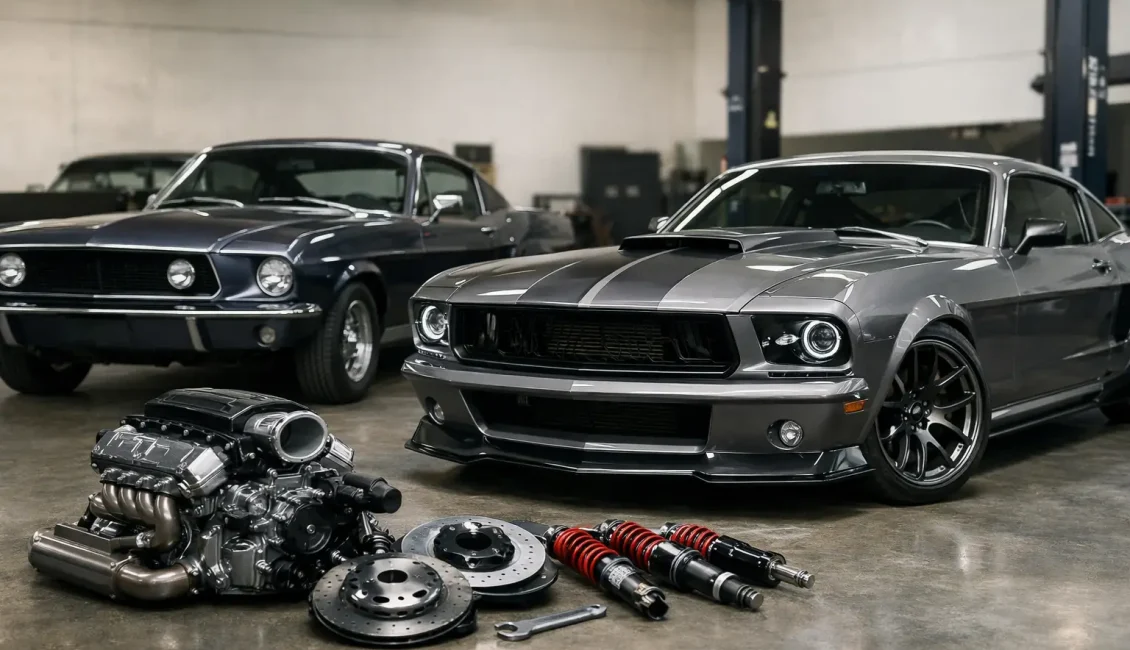
A beautifully restored classic can stop you in your tracks. A beautifully executed restomod can do that, then leave the showground with modern braking, confident steering and enough performance to make the journey home part of the occasion. That is the appeal of restomod culture: it respects the shape, character and story of an older car while making it more rewarding to use in the real world.
For some enthusiasts, the original-specification car will always be the pinnacle. For others, a classic that starts readily, cruises comfortably and can be driven hard with confidence is the more compelling proposition. Neither view is wrong. The interesting part is the conversation between them, and the extraordinary standard of engineering that conversation is bringing to Britain’s classic-car scene.
What makes a car a restomod?
The word combines restoration and modification, but it covers a broad spectrum. At one end is a sympathetic build: uprated brakes, electronic ignition, improved cooling, discreet suspension changes and a more usable cabin. At the other is a full re-engineering project, where a familiar body shape sits over a bespoke chassis, modern drivetrain, contemporary electronics and hand-finished interior.
The common thread is intention. A restomod is not simply an old car with a louder exhaust or a set of wheels chosen for shock value. The strongest builds start with a clear idea of how the car should feel. It might be a 1960s sports car made fit for long continental trips, a classic Mini with enough chassis control for a fast B-road, or a grand touring saloon that can cope with modern traffic without losing its period presence.
Good restomods make upgrades feel considered rather than bolted on. The engine, gearbox, brakes, tyres and suspension should work together. So should the visual details. A car can have fuel injection, air conditioning and a six-speed gearbox without advertising every alteration from fifty paces away.
Why restomod culture is gathering pace
Classic motoring has always involved personal taste. Owners have tuned, repaired and improved cars since cars first became objects of affection. What has changed is the quality of the parts, specialist knowledge and finish now available. Modern manufacturing allows small workshops to produce components that would once have been impossible or prohibitively expensive, while established restoration businesses have become increasingly adept at combining traditional craft with current engineering.
There is also a practical reason for the movement. Traffic is faster, roads are busier and expectations have changed. A standard classic can be hugely enjoyable, but weak headlights, marginal cooling, vague brakes or an unsettled ride can limit how often it comes out of the garage. Thoughtful upgrades can turn an occasional sunny-Sunday machine into something that sees regular use.
That usability matters. Cars gain their best stories on the road: the early start for a breakfast meet, the queue of classics arriving at a country estate, the wet run home after a show, and the unexpected conversation at a petrol station. A restomod gives many owners the confidence to make more of those moments.
Performance is part of the attraction too, but it is not always about chasing the biggest number. An extra 50bhp can be enjoyable; so can a lighter flywheel, sharper throttle response, better damping or a gearbox with ratios suited to motorway miles. The most satisfying builds often feel quicker because they are more composed and more predictable, not because they are trying to overwhelm the original car’s character.
The originality question
Restomod culture can be divisive, particularly when a rare or historically significant car is involved. That concern deserves respect. Some vehicles are important records of design, competition history or social history. Once an original shell, engine or interior is permanently altered, something irreplaceable may be lost.
The answer depends on the car and the work. A carefully preserved matching-numbers example may be best left close to factory specification. A tired, incomplete or previously altered vehicle can be an ideal candidate for a fresh direction. Reversible modifications offer a sensible middle ground, allowing an owner to improve safety and drivability while retaining the original parts for the future.
Provenance should never be hidden. A credible seller is clear about what has changed, who carried out the work and how the build has been maintained. That honesty protects buyers and lets the car be appreciated for what it is, rather than what someone hopes it might be.
There is room at a great motoring show for the concours-standard survivor, the lovingly restored home project and the radically reimagined restomod. Seeing them side by side makes the heritage richer, not poorer. Each represents a different relationship with the same marque or era.
Where engineering meets personality
The best restomods are rarely defined by one headline component. They are built around hundreds of decisions, from the steering rack ratio and spring rates to seat support, sound insulation and the finish of the switchgear. That is why a well-executed car feels coherent. It has a point of view.
Take a classic performance coupe. Its owner may want the period silhouette, slim pillars and analogue driving experience, but also the ability to use it on a wet October morning. Modern tyres and brakes may be essential. Better lighting and corrosion protection make sense. The interior could retain traditional materials while gaining discreet navigation, charging and ventilation. Done well, the result does not feel like a museum piece or a new car wearing old clothes. It feels like the car the original designers might have made with more time, budget and technology.
This is also where craftsmanship matters. A paint finish can be flawless, but poor panel gaps, untidy wiring or mismatched mechanical choices will soon undermine a build. Enthusiasts notice the details. At shows, the cars that draw a crowd are often the ones that reward a closer look: the neatly routed brake lines, the thoughtfully retrimmed cabin, the engineering tucked beneath a factory-looking bonnet.
Restomods belong at live motoring events
Photographs can show stance and paintwork, but they cannot communicate the full presence of a restomod. At a live event, visitors can study the workmanship, speak to the owner and hear why a particular engine, colour or suspension set-up was chosen. That exchange is a major part of the culture.
Restomods also create useful cross-generational conversations. Someone who grew up with a particular model may be drawn in by its familiar lines, while a younger visitor sees a classic that looks exciting, attainable in spirit and relevant to the roads they know. Families can enjoy the spectacle, while serious builders can compare techniques and suppliers with fellow enthusiasts.
That breadth is one reason cars of every style sit so naturally together at Great British Motor Shows. A pristine original, a club display, a race-inspired project and a high-end restomod all give visitors a reason to stop, ask questions and keep looking. The variety is the point.
Buying or building with clear eyes
Restomods can command serious money, especially when the donor car is desirable and the work comes from a recognised specialist. A premium is understandable when it reflects quality fabrication, properly developed engineering and comprehensive documentation. It is less convincing when the price rests solely on fashionable parts or a dramatic social-media presence.
Anyone considering a purchase should look beyond the specification list. Ask how the car was built, whether the modifications are recorded, and whether replacement parts will remain available. Examine the quality beneath the paintwork. A test drive should reveal a car that tracks straight, stops cleanly, runs at a sensible temperature and behaves consistently, rather than one that merely feels exciting for ten minutes.
For home builders, defining the brief before buying parts can save considerable money. Decide whether the priority is touring, fast-road driving, show presentation or track use. A car intended for weekend journeys needs a different balance from one built for outright lap times. It is tempting to modify every system at once, but a staged approach makes it easier to understand what each change has achieved.
Insurance, declared modifications, MOT requirements and the legal implications of major structural or engine changes all need attention. A brilliant build should be enjoyable without becoming a paperwork headache. Reputable specialists and enthusiast communities can be invaluable here, particularly when it comes to safety-critical work.
A culture built to be driven
Restomod culture is not a rejection of originality. At its best, it is an expression of affection for cars whose shapes, sounds and driving manners still matter. It asks a simple question: how can we keep these machines meaningful on modern roads?
The answer will be different for every owner. Preserve one car exactly as it left the factory. Improve another so it can tackle a Scottish road trip, a summer show season or the weekly commute with confidence. The most important thing is that the choices are thoughtful, the workmanship is honest and the car continues to create the sort of excitement that makes people gather around it in the first place.