
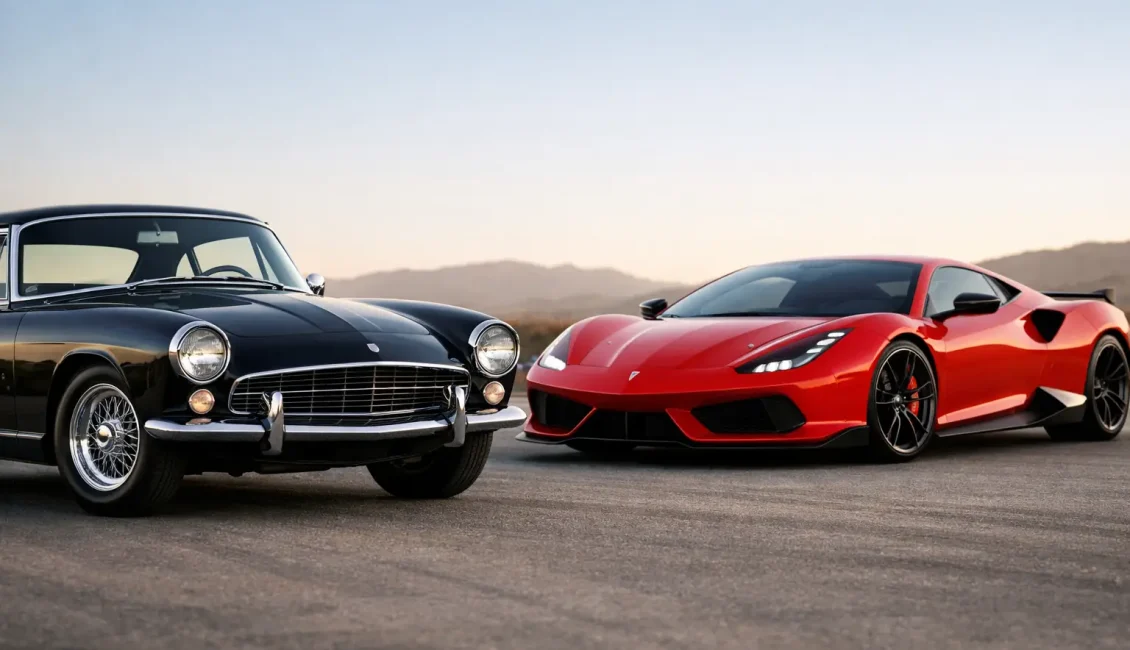
One draws a crowd with the smell of old leather, polished chrome and a story that started decades ago. The other stops people in their tracks with low-slung bodywork, outrageous performance and the sort of presence that turns a quiet arrival into an event. Classic cars versus supercars is not really a battle to settle once and for all. It is a question that says a lot about what you value as an enthusiast.
At any good motor show, that contrast is part of the magic. You can spend one hour admiring the hand-finished details of a British sports car from another era, then round the corner and find yourself face to face with a modern machine built to hit incredible speeds while looking like it has rolled straight off a poster. Both have star quality. They simply deliver it in very different ways.
Classic cars versus supercars – what are you really choosing?
On paper, the difference looks obvious. Classic cars trade on heritage, design history, craftsmanship and nostalgia. Supercars are about cutting-edge engineering, huge power figures, advanced materials and theatre. Yet the real decision is not old versus new. It is experience versus spectacle, simplicity versus complexity, and often emotion versus outright pace.
For many enthusiasts, classic ownership starts with a connection that feels personal. It might be a car your parents once had, a shape you remember from old motorsport footage, or a model that represents a lost age of motoring. A classic can feel alive in a way modern cars rarely do. The steering is often less filtered, the cabin more mechanical, and every drive asks something of you.
A supercar creates a different sort of bond. It is about the intensity of the machine and the sense that modern engineering has pushed right to the edge of what is road legal. The acceleration is brutal, the grip is astonishing and the road presence is impossible to ignore. Even standing still, a supercar feels dramatic.
That is why the debate stays interesting. The better choice depends on whether you want a car that invites you into its past, or one that overwhelms you with its present.
The appeal of classics never really fades
Classic cars have a way of slowing people down. They make you look closer. You notice the proportions, the brightwork, the dials, the coachbuilt details and the design cues that defined an era. They are not just transport. They are rolling pieces of culture.
Part of the appeal is accessibility. Not every classic is a six-figure collector item. Plenty of enthusiasts enter the scene through modest saloons, roadsters, hot hatches and coupes that still offer character without demanding a museum budget. That matters because classic car culture has always been broader than the rarest concours examples. It lives in club stands, home garages, Sunday runs and conversations between owners who know exactly how long it took to source that one elusive part.
There is also satisfaction in the ownership experience itself. A classic often encourages hands-on involvement. You learn the quirks, the sounds and the maintenance routine. You become part driver, part custodian. For some people, that is the whole point.
Of course, there is a trade-off. Classics can be temperamental. Reliability varies. Parts availability depends on the make and model. Safety, refinement and comfort are rarely on modern terms. A beautiful 1960s coupe may charm on a sunny afternoon, but it will not necessarily feel relaxing in stop-start traffic on a wet weekday.
Still, that compromise is exactly why many owners love them. A classic asks for commitment, and in return it gives you character by the bucketload.
Why supercars dominate the modern dream
Supercars are built to provoke a reaction, and they usually get one long before the engine is started. The styling is sharper, lower and more dramatic than almost anything else on the road. They are designed not to blend in, but to make an entrance.
Then there is the performance. Even by modern standards, the best supercars feel outrageous. The power delivery is savage, braking is immense and the level of grip can seem to defy common sense. Where classics reward rhythm and mechanical sympathy, supercars reward confidence and commitment.
They also represent the latest thinking in automotive engineering. Lightweight construction, active aerodynamics, advanced electronics and beautifully complex drivetrains all play a part. For enthusiasts who admire technical progress as much as driving excitement, that matters just as much as the badge on the bonnet.
But supercar ownership has its own compromises. Running costs can be significant. Servicing is not optional and rarely cheap. Depreciation can bite, depending on the model and market. Some cars are more enjoyable on paper than on real British roads, where width, visibility and firm ride quality can quickly become part of the conversation.
There is also the question of usability. A supercar can be thrilling for a weekend blast or a show appearance, but not every owner wants that level of attention every time they stop for petrol. That spotlight is part of the attraction for some and a drawback for others.
Classic cars versus supercars at live events
This is where the debate becomes less about ownership and more about atmosphere. At a live show, classics and supercars do different jobs, and both matter.
Classic displays tend to draw people into conversation. Visitors linger. Owners talk history, restoration, provenance and period detail. Families point out cars they remember from their childhood. Club stands often have that warm, social energy that turns a display line into a proper community space.
Supercars bring a different pulse. They create excitement from a distance. Younger visitors are instantly pulled in. Cameras come out. People compare specifications, styling and rarity. The atmosphere becomes more fast-paced, more aspirational, and undeniably more theatrical.
That mix is exactly why broad-category events work so well. One visitor may arrive for vintage British motoring and leave having spent half an hour admiring contemporary Italian exotica. Another may come for modern performance and discover a new appreciation for pre-war design or analogue sports cars. The best events give both sides room to shine.
For Great British Motor Shows, that variety is part of what makes a day out feel full. You are not choosing one corner of motoring culture at the expense of another. You are seeing the whole story, from heritage to horsepower, in one place.
Which is better to own?
That depends on what sort of enthusiast you are.
If you enjoy tinkering, researching, joining owner clubs and taking pride in preserving a piece of motoring history, a classic may suit you better. The ownership journey can feel richer, even when it is less convenient. There is pleasure in the imperfections.
If you want dramatic performance, modern capability and the thrill of owning something truly exotic, a supercar will hold obvious appeal. It is a different level of event every time you open the garage. The convenience may still be limited, but the excitement is immediate.
Budget matters too, though not always in the way people assume. Entry-level classic ownership can be more achievable than many expect, while serious restorations can absorb huge sums. Supercars command bigger purchase prices at the sharp end, but the running costs are often what catches people out. Insurance, servicing, tyres and specialist care all come with the territory.
Storage matters. Usage matters. Patience matters. There is no universal answer because the best car is the one that fits the life you actually lead, not the image you have in your head.
The emotional case for both sides
Ask ten enthusiasts to choose between a perfectly restored classic and a modern supercar, and you will get ten different versions of the same truth. Cars are rarely rational purchases. They are emotional ones.
A classic can feel like memory made metal. It connects people to an era, a sound, a shape or a sense of occasion that newer cars often struggle to replicate. A supercar taps into a different emotion – ambition, adrenaline, spectacle and the idea that driving can still feel wildly special in a world full of sensible compromises.
That is why the smartest answer to classic cars versus supercars is often not either-or. It is understanding what each brings to the scene. One celebrates where motoring has been. The other shows how far it can go. Put them together at the right event, in the right setting, and the contrast makes both even more exciting.
If you are weighing up your own preference, do not ask which one is objectively better. Ask which one keeps you looking back after you have parked it, and which one you would cross the country to see on a show field. That is usually where your answer starts.