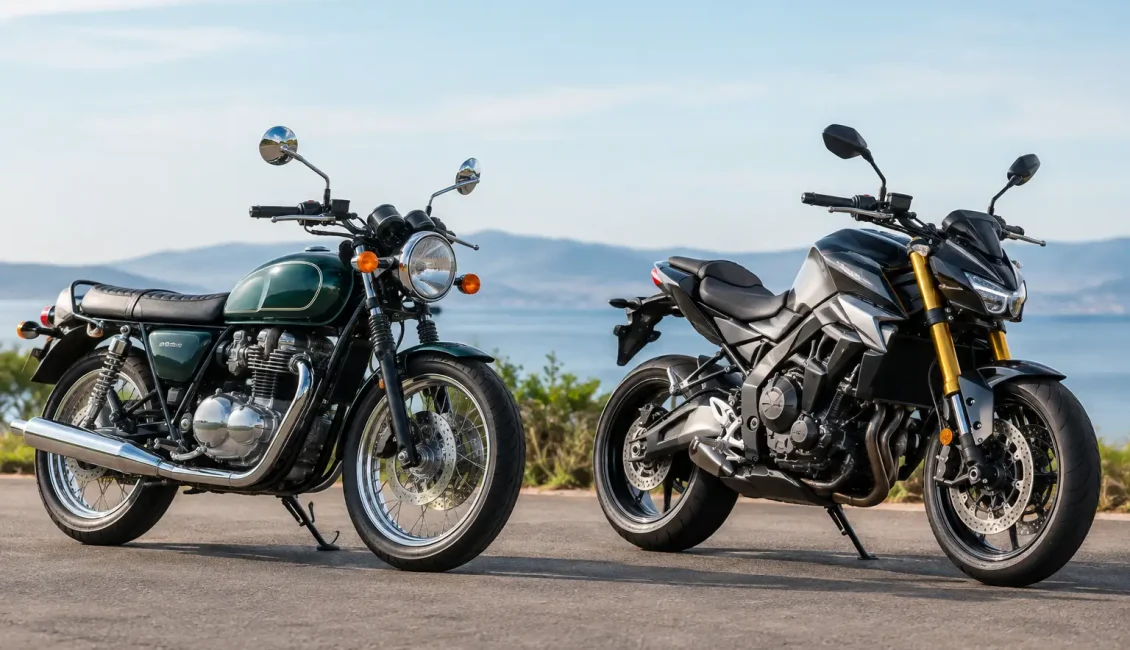
A polished Norton outside a country house, a crisp new Triumph firing into life, a row of Japanese two-strokes drawing a crowd – the classic bike versus modern bike debate is never just about getting from A to B. It is about the sort of rider you are, the roads you enjoy and what makes you look back at your machine after you have parked it.
For some, a motorcycle should involve kick-starts, carburettors and the satisfying responsibility of keeping mechanical parts in tune. For others, it should start every time, stop hard in the wet and cover a full day’s riding without asking for much more than fuel. Both views are valid. The better choice depends on how, where and how often you plan to ride.
Classic Bike Versus Modern Bike: The Real Difference
A classic motorcycle offers a direct connection between rider and machine. Its engineering is generally visible and understandable: cables, cooling fins, exposed fasteners and engines that invite a closer look. There is a sense of occasion in the whole process, from rolling it out of the garage to settling into the rhythm of the road.
Modern bikes are designed around capability. Fuel injection, advanced suspension, powerful brakes, refined tyres and, on many machines, selectable riding modes give riders more control in more conditions. A current middleweight roadster may be quicker, safer and easier to live with than a large-capacity classic, while using less fuel and needing less fettling.
That does not make a modern bike soulless, nor does it make every classic a temperamental weekend ornament. There are wonderfully dependable older machines and plenty of modern motorcycles with a strong personality. The key distinction is where each type asks you to compromise.
Character and the Feel of the Ride
Classic bikes tend to turn even a short run into an event. The mechanical soundtrack is less filtered, the controls can feel heavier and the pace often encourages you to enjoy the journey rather than chase the destination. An old British twin, Italian single or Japanese four-cylinder carries the design language and engineering priorities of its era. You are riding a piece of motoring history, complete with its quirks.
Those quirks matter. A classic may need a deliberate warm-up, careful choke use or a firm kick on the starter. Its gearbox may require patience and its brakes may feel modest beside a modern set-up. For many owners, that involvement is exactly the appeal. Riding well becomes a skill, not a setting selected on a dashboard.
Modern motorcycles provide a different kind of enjoyment. They can be composed, responsive and remarkably confidence-inspiring on demanding roads. Better chassis balance and suspension make a noticeable difference when surfaces are broken, bends tighten or a passenger climbs aboard. A new bike can also make longer trips more realistic, particularly when wind protection, heated grips, luggage and electronic cruise control are part of the package.
If your ideal Sunday is a relaxed ride to a meet, with time for conversations in the car park, a classic has enormous charm. If it is an early start, several counties of B-roads and a ride home after dark, modern refinement starts to earn its place.
Performance Is More Than Horsepower
It is easy to compare specification sheets and assume the newer bike wins every contest. On paper, it usually does. Modern engines produce stronger, cleaner and more consistent power, while contemporary brakes and tyres transform stopping distances and cornering confidence.
But performance on the road is not solely about speed. A 1960s or 1970s machine can be hugely rewarding at sensible speeds because it communicates so much. The engine note changes, the chassis moves beneath you and every input feels meaningful. You may not be travelling as quickly, but you may feel more connected to the experience.
Modern power can also be more usable. Fuel injection compensates for changing temperatures and altitude, traction control can offer a welcome safety net on greasy roads, and ABS is particularly valuable in an emergency. For newer riders, commuters and anyone who rides through an unpredictable British season, those advantages are practical rather than theoretical.
Ownership: Time, Tools and Running Costs
Before buying a classic, be honest about your appetite for maintenance. Routine work is often straightforward, and that is one of the pleasures of ownership. You can learn your bike’s character through oil changes, valve checks, ignition timing and carburettor balancing. Parts availability is strong for many popular models, supported by knowledgeable specialists and enthusiastic owners’ clubs.
Yet classic ownership is not always cheap. A proper restoration, scarce original components and specialist labour can add up quickly. A bike that appears affordable at purchase may need tyres, seals, wiring repairs, a fuel-system rebuild and suspension work before it is genuinely ready for regular use. Condition and documentation matter far more than shiny paint alone.
Modern bikes need servicing too, but intervals are usually longer and reliability is generally higher. Their complication can be a drawback for home mechanics, however. Diagnostic equipment, electronic faults and densely packaged components may mean a trip to a dealer or specialist. Replacement bodywork, LED lighting and electronic control units can be expensive after even a minor mishap.
Insurance, tax and storage should also enter the calculation. Many older motorcycles may qualify for historic vehicle tax once they meet the relevant age rules, while classic insurance can be attractive for low-mileage leisure use. Conversely, a newer machine may be more suitable if you need one bike for commuting, touring and everyday errands. Check local emissions requirements too, especially if your riding includes larger cities and their clean-air zones.
Safety Without Spoiling the Fun
There is no escaping the safety gap. Modern motorcycles benefit from decades of development in braking, tyres, frame stiffness, suspension damping and rider aids. Even a modest current bike can be far more forgiving than a revered classic when the weather turns or an unexpected hazard appears.
That need not rule out older machinery. It simply changes the approach. Give yourself more space, ride within the bike’s limits and keep it mechanically sound. Period brakes and tyres deserve respect, particularly after winter storage or when rain has polished the roads. Sensible upgrades, where appropriate and sympathetic to the machine, can improve safety without erasing its character.
Protective kit has moved on as well. A classic jacket and open-face helmet may look the part, but modern CE-rated clothing, gloves, boots and a quality full-face helmet offer worthwhile protection whatever sits beneath you.
Which Bike Suits Your Garage?
Choose a classic if you enjoy hands-on ownership, value heritage and can accept that a ride may occasionally become a repair session. It is an excellent choice for fair-weather runs, club gatherings and owners who appreciate the story behind a particular marque or model. Buy the best, most complete example your budget allows, ideally one with evidence of careful maintenance rather than a vague promise that it ‘only needs finishing’.
Choose modern if you want dependable transport, frequent use and confidence across varied weather and road conditions. It suits riders who want to tour, commute, carry a pillion or build miles without constantly watching gauges and listening for unfamiliar noises. Modern does not have to mean anonymous either: retro-styled roadsters, adventure bikes, sports machines and naked bikes all bring very different flavours.
There is a third answer, and it is often the most satisfying one: own one of each. A modern bike can handle the practical miles, while a classic waits for bright mornings and special occasions. At a Great British Motor Shows event, that contrast is part of the attraction – immaculate heritage machines alongside contemporary performance bikes, each drawing admirers for entirely different reasons.
The Bike That Gets Ridden Is the Right One
Do not buy a classic merely because it is admired, and do not buy a modern bike simply because it is faster. Sit on both. Listen to them. Think about your favourite roads, your available garage time and whether you want to polish, tinker, tour or simply press the starter and go.
The best motorcycle is the one that makes you plan the next ride before the current one has ended. Whether that comes with a kick-start lever or a dashboard full of electronics is entirely up to you.