
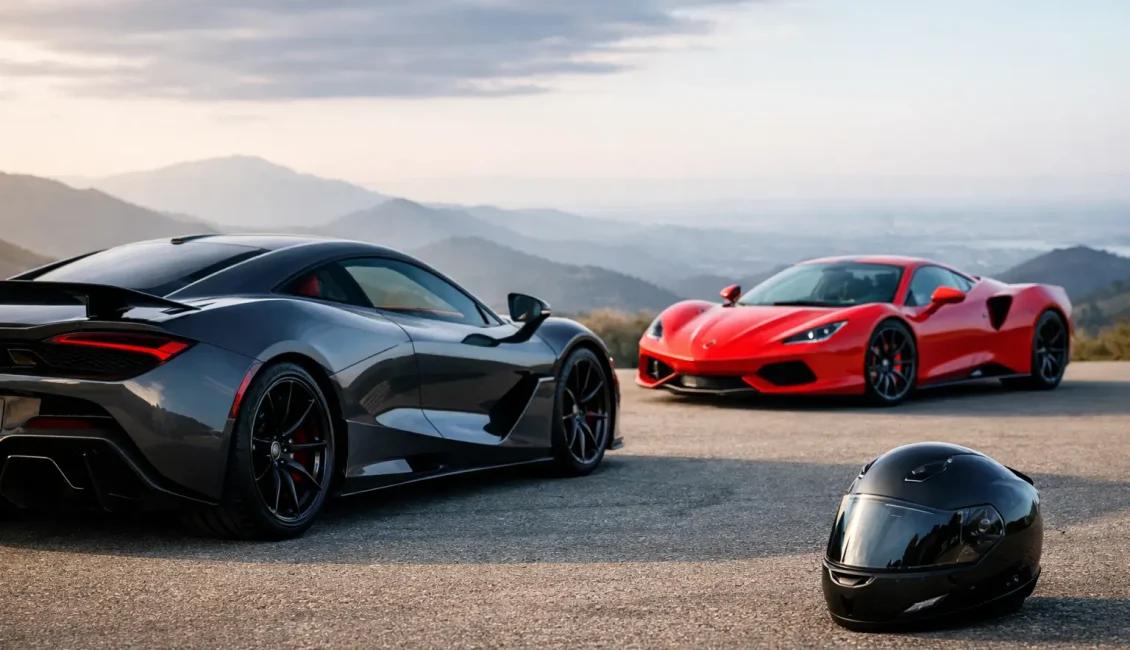
You know the feeling before you even read the badge. A car arrives, the crowd shifts, phones come out, and suddenly everyone nearby is paying attention. That instant sense of occasion is part of what makes a supercar, but not all of it. Plenty of fast cars exist. Plenty of expensive cars exist too. A supercar sits in a rarer space where performance, design, drama and desirability all meet.
That is why the question matters. If you spend time around performance cars, whether at a Sunday meet, a major launch or a packed showground, you quickly realise the term gets used loosely. Some people call any quick coupe a supercar. Others save it for the truly exotic. The truth sits somewhere in between, and it is more interesting than a simple power figure.
What makes a supercar beyond raw speed?
Speed is the headline, but it is not the whole story. If straight-line pace alone settled the argument, a heavily tuned saloon or an electric performance car with huge acceleration figures would automatically qualify. Sometimes they do feel supercar-fast, but they do not always feel like supercars.
A supercar needs pace that feels serious in the context of its era. That usually means exceptional acceleration, a high top speed, sharp braking and the kind of handling that makes the car feel built for more than just commuting and dual carriageways. It should feel specialised. There has to be intent in the way it is engineered.
But pace without theatre is only half the job. The car also needs presence. It should look different from ordinary traffic and, frankly, from most sports cars too. Low stance, wide bodywork, dramatic air intakes, a cabin set far forward or far back, wheels that properly fill the arches – these details matter because they signal purpose before the engine is even started.
Then there is the emotional side. A supercar is not merely measured by lap times. It should create a reaction. The sound, the seating position, the visibility, the sense that this machine was built to stir something in you – that is central to the category.
Performance matters, but context matters more
Figures can be deceptive because every era moves the goalposts. A Ferrari F40, Lamborghini Diablo and Honda NSX were all unquestionably supercars, yet by modern standards some family EVs can match or beat parts of their acceleration numbers. Nobody would argue that makes the older cars less special.
What mattered then, and still matters now, is how far a car pushes the standard for road-going performance. A supercar should feel like it sits near the top of the food chain for its time. It does not need to be the single fastest thing on sale, but it should be part of that conversation.
There is also a difference between being quick and being engineered as a performance-first machine. A very fast grand tourer may have huge power and a six-figure price tag, but if its main brief is effortless long-distance comfort, many enthusiasts will stop short of calling it a true supercar. Equally, a stripped-back sports car might deliver thrilling handling but lack the breadth, prestige or drama usually expected at this level.
That grey area is part of the appeal. Categories in the car world are rarely neat, and supercars are no exception.
Design is a big part of what makes a supercar
If you have to explain why a car is special, it may already be losing the argument. The strongest supercars announce themselves immediately. Their proportions are different because the engineering underneath is different. Mid-engine layouts, advanced cooling needs and aerodynamic priorities all shape the body.
That does not mean every supercar has to be outrageous. Some, like the early Audi R8, earned respect through cleaner lines and everyday usability. Others lean fully into drama with scissor doors, vast rear diffusers and bodywork that looks like it belongs on a poster. Both approaches can work, as long as the design feels deliberate and memorable.
A supercar should also have a sense of occasion inside. The driving position is often low and cocooned. Materials usually move beyond the purely practical into the tactile and special. Carbon fibre, machined metal, fine leather and race-inspired details all help. Even where the cabin is not luxurious in the traditional sense, it should still feel distinct from a normal production car.
Engineering depth separates supercars from fast status cars
This is where the conversation gets serious. A supercar is not just a body kit wrapped around a big engine. It needs engineering substance.
That can mean a lightweight chassis, advanced suspension, active aerodynamics, carbon-ceramic brakes, sophisticated traction systems or a powertrain developed to deliver performance repeatedly rather than once for a magazine test. The details vary, but the common thread is that the car is built around the pursuit of high performance.
The best supercars also carry some transfer of knowledge from motorsport or top-level engineering programmes. Not every supercar has a direct racing link, but many borrow ideas from competition in materials, aerodynamics or packaging. That technical pedigree adds credibility.
It is also one reason why rarity alone is not enough. A hand-built, expensive car can be exclusive without being a supercar. To earn that label, it has to do more than be scarce and glamorous. It needs the hardware to back up the image.
Rarity, desirability and the badge effect
Badges matter more than many enthusiasts like to admit. Ferrari, Lamborghini, McLaren and Porsche have all built reputations that shape how their cars are perceived before the engine fires. Heritage counts because it creates expectation. When one of those brands launches a new halo model, the world pays attention.
Still, a famous badge does not guarantee supercar status on its own. A brand can make a sports car, a grand tourer and a supercar at different price points. The model itself has to earn the title.
Rarity helps because supercars are meant to feel exceptional. You are not supposed to see dozens every morning on the school run. Limited production, high price and specialist ownership all contribute to that sense of exclusivity. Yet there is a balancing act here. Some cars become so rare and valuable that they move from supercar into hypercar territory, where the conversation shifts again.
For most enthusiasts, a supercar sits in that sweet spot where it is special enough to stop you in your tracks but still recognisable as a road car you might realistically see at a major event or hear arriving from the car park.
What makes a supercar at a show? Presence
This is where the category comes alive. On paper, two cars can be similarly quick and similarly expensive. In person, one can dominate the scene while the other barely turns a head. Presence is hard to quantify, but every enthusiast recognises it.
A proper supercar creates theatre even when stationary. Doors open and people gather. Children point. Long-time petrolheads start talking about engine layouts, production numbers and the sound they heard on the way in. It becomes part of the event atmosphere.
That is why supercars remain such a draw at live motoring events. They are not just transport or statistics. They are spectacle. They connect the engineering side of car culture with the emotional side, and that combination brings all kinds of visitors together – from seasoned collectors to families seeing one up close for the first time.
At a Great British Motor Shows event, that mix is exactly what gives a showground its energy. A supercar does not have to be the oldest, rarest or most modified vehicle there to command attention. It simply has to deliver that unmistakable sense that you are standing near something a bit extraordinary.
So where is the line between a sports car and a supercar?
This is the question that sparks most debate. A sports car is built for driving enjoyment and performance, but it does not always chase the same extremes. Cars like the Porsche Cayman, Alpine A110 or Lotus Emira are thrilling machines, yet many enthusiasts would place them just below supercar territory because they are more focused, more attainable or less theatrical.
A supercar usually turns everything up. More power, more visual drama, more exotic engineering, more rarity, more event. It asks for compromise as well. Visibility may be worse. Running costs are higher. Luggage space may be laughable. Ride quality can be firm, and everyday practicality often takes a back seat.
That trade-off is part of the point. Supercars are not meant to be sensible in the usual way. They are meant to feel a little excessive, because that excess is what creates the magic.
Of course, modern cars have blurred the boundaries. Some supercars are now remarkably civilised at low speeds and easier to live with than older hot hatchbacks. Even so, the category still depends on that sense of elevated experience. If it feels too ordinary, no amount of horsepower can fully save it.
The best way to judge it is simple. Ask whether the car delivers genuine performance, distinctive design, serious engineering and a sense of occasion that starts before the wheels turn. If it does all four, you are probably looking at a supercar. And if one rolls into view and the whole crowd instinctively moves closer, that is usually your answer as well.
The next time you see one in the metal, do not just look at the numbers board or the badge. Listen to the reaction around it. Supercars have always been about more than speed, and that is exactly why they still matter.