
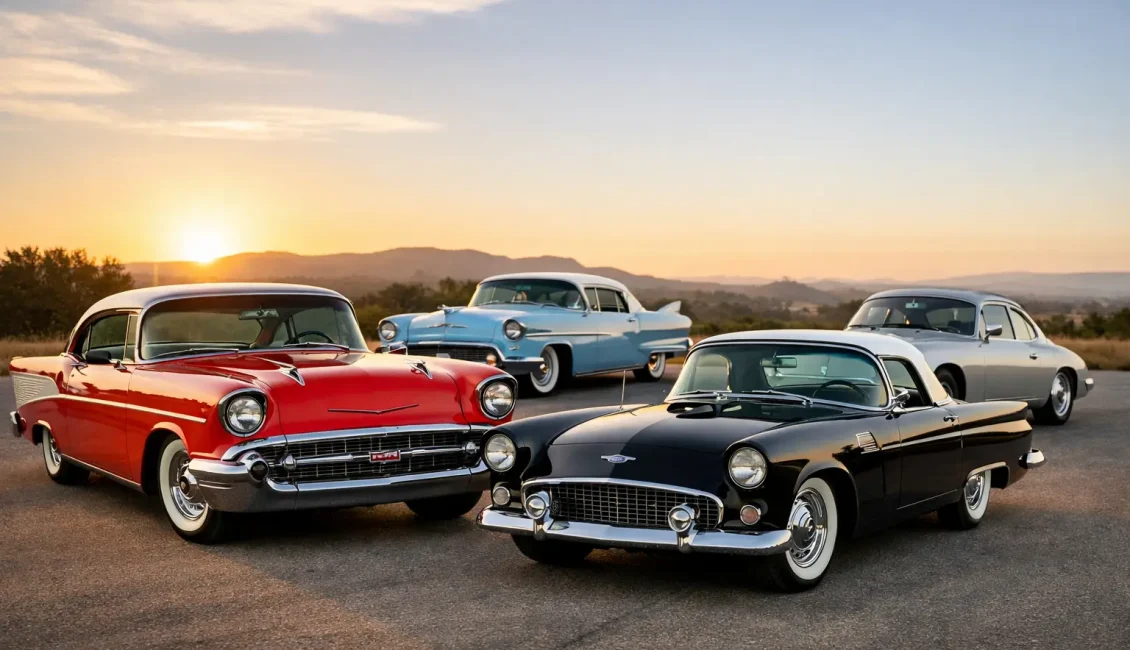
Few sights stop a show field in its tracks like a truly great 1950s car. The best classic cars of the 50’s have that effect – chrome flashing in the sun, tailfins catching the eye, and bodywork so full of confidence it still feels fresh more than half a century later. It was a decade when car design became bolder, engineering moved quickly, and manufacturers started building machines that were not just transport, but statements.
That is what makes the 1950s such a strong era at any live event. These cars bring glamour, optimism and a sense of occasion the moment they roll through the gates. Some were built for speed, some for comfort, and some simply to make neighbours stare through the curtains. The very best do all three.
What makes the best classic cars of the 50’s stand out?
The 1950s did not produce one single type of classic. Britain was turning out elegant roadsters and compact saloons, America was going all-in on scale and style, while Italy and Germany were refining performance and prestige. That means judging the best classic cars of the 50’s is never just about power figures or auction values.
It is about presence, influence and how a car makes people feel in person. Some models changed the market. Others became cultural shorthand for cool. A few are simply so well proportioned and so charming that they win over almost everyone, whether they arrived as lifelong collectors or just came along for a family day out.
12 best classic cars of the 50’s
Mercedes-Benz 300SL Gullwing
If one car captures the ambition of the decade, it is the 300SL Gullwing. Those doors still create a crowd the instant they lift, but this was far more than a styling party piece. It was fast, technically advanced and genuinely exotic.
For many enthusiasts, the Gullwing sits near the top because it combines rarity, motorsport credibility and stunning design without feeling overblown. The trade-off, of course, is accessibility. It is a dream machine rather than a realistic ownership proposition for most people, but as an icon of the era, it is untouchable.
Jaguar XK120
Britain had no shortage of handsome machinery in the 1950s, and the Jaguar XK120 remains one of its finest moments. Long bonnet, flowing wings and a cabin that looks every bit the part, it delivered genuine performance with real elegance.
What makes the XK120 so enduring is that it still feels usable as well as collectible. It has glamour, but not in a delicate, untouchable way. On a show stand or parked on the lawn of a country venue, it always looks exactly where it belongs.
Chevrolet Bel Air
You cannot talk about the decade without talking about America, and the Chevrolet Bel Air is one of its most recognisable stars. The 1957 car in particular has become shorthand for the whole era – bright trim, sweeping lines and enough visual swagger to light up any row of classics.
It is not subtle, and that is the point. The Bel Air celebrates the 1950s at full volume. For UK enthusiasts, that scale and flash is part of the appeal, though ownership can mean a bit more planning when it comes to storage, fuel and sourcing the right parts.
Austin-Healey 100
If you like your classics purposeful rather than plush, the Austin-Healey 100 deserves its place. It has a muscular, no-nonsense look and the sort of stance that promises fun before the engine has even fired.
This is one of the best classic cars of the 50’s for drivers who value involvement. It is not about isolation or luxury. It is about a direct connection to the road, a raspy soundtrack and a shape that remains properly handsome. At a live show, it often attracts the crowd that wants to talk engineering as much as paint finish.
Porsche 356
The Porsche 356 has a quieter confidence than some of the decade’s louder creations, but that is part of its charm. Clean lines, compact dimensions and a reputation for precision have made it one of the most admired post-war sports cars.
It also shows how varied the 1950s were. Next to a giant American cruiser, the 356 looks restrained. Next to many small British cars of the period, it looks sophisticated and finely resolved. It is not the cheapest route into classic Porsche ownership anymore, but its appeal runs deep for good reason.
Cadillac Eldorado
If excess had an official car, the Eldorado would be in the running. Big, gleaming and gloriously theatrical, it represented the luxury end of American optimism. These were cars designed to be seen.
There is always debate about whether the Eldorado is one of the best or simply one of the boldest. Fair question. It is not for everyone, and British roads can make a car of this size feel like a very committed lifestyle choice. But as rolling spectacle, few 1950s cars do it better.
Alfa Romeo Giulietta Sprint
The Giulietta Sprint proves that a classic does not need huge dimensions or headline power to become special. It is compact, elegant and wonderfully balanced in the way so many great Italian cars are.
For enthusiasts who appreciate detail, this is a deeply rewarding machine. The proportions are spot-on, and the whole thing has a lightness of spirit that still feels refreshing. It is the sort of car that draws a knowing nod rather than a loud reaction, then keeps people looking longer than they expected.
Aston Martin DB2/4
Aston Martin’s DB2/4 represents British grand touring at its most appealing. It is refined without being stuffy, sporting without being harsh, and handsome without trying too hard. That balance is not easy to achieve.
It also sits in an interesting middle ground. It does not have the instant broad recognition of a Gullwing or a Bel Air, but among enthusiasts it carries real weight. At an event packed with standout metal, a DB2/4 often wins admiration the old-fashioned way – by being quietly excellent.
Ford Thunderbird
The first-generation Thunderbird gave Ford something stylish, aspirational and very distinctly American. It was less of an all-out sports car than some expected, but that did not hurt its legacy. In many ways, its mix of comfort and image is exactly why it worked.
This is one of those classics where context matters. If you want razor-sharp dynamics, there are better choices. If you want presence, charm and easy period glamour, the Thunderbird is a very strong contender.
Morris Minor 1000
Not every great 1950s classic has to be exotic. The Morris Minor 1000 earns its place because it represents everyday British motoring at its most lovable. It is approachable, cheerful and woven into the national memory in a way few cars can match.
That familiarity is its strength. Plenty of visitors at classic events have a family story connected to a Minor, and that emotional pull matters. It may not be the fastest or rarest car on this list, but in terms of affection and recognisable character, it is one of the strongest.
Ferrari 250 GT Coupe
The 1950s Ferrari formula remains hard to resist – front-engined V12 power, elegant coachwork and genuine racing DNA in the brand’s bloodstream. The 250 GT Coupe captures that blend beautifully.
It is also a reminder that the best classics can be polished without becoming sterile. This is a sophisticated machine, but it still has real edge to it. Values have pushed these cars into serious collector territory, yet their appeal at ground level remains simple enough: they are stunning to look at and thrilling to imagine on the move.
Citroen DS
When the Citroen DS arrived, it must have looked like it had driven in from the future. Even now, its shape and engineering feel daring. Hydropneumatic suspension, aerodynamic thinking and an interior unlike anything else on the road gave it a unique place in motoring history.
Not everyone falls for the DS in the same way they do for a chrome-heavy sports car, but that is what makes it so important. It shows another side of 1950s greatness – innovation. If your idea of the best classic cars of the 50’s includes engineering bravery as well as beauty, it has to be here.
Why 1950s classics still pull a crowd
Part of the answer is simple: they look fantastic. The decade gave us curves, fins, grilles, wraparound screens and cabins full of character. Modern cars may be quicker and safer, but they rarely offer this much visual theatre standing still.
The other reason is emotional range. A 1950s car can trigger nostalgia, admiration or pure curiosity depending on who is looking at it. Collectors appreciate craftsmanship. Younger enthusiasts often connect with the design drama. Families see something cheerful and memorable. That broad appeal is exactly why these cars remain stars of the show scene, whether they are concours-level restorations or honest survivors with a few stories to tell.
Choosing your own favourite from the 1950s
This is where personal taste really takes over. Some people want the glamour of a Mercedes-Benz 300SL or a Ferrari 250 GT. Others would choose the warmth and familiarity of a Morris Minor or the open-top punch of an Austin-Healey. There is no single correct answer, because the decade offered so many different ways to be brilliant.
If you are viewing these cars as a potential owner, it pays to think beyond looks. Parts support, specialist knowledge, storage, running costs and usability all matter. A car that feels perfect on a sunny showground may ask a lot more of you at home. But if you are choosing with your heart, the 1950s make that very easy.
See enough of them gathered together and the decade starts to make perfect sense. It was ambitious, stylish and gloriously varied. And when one of these machines catches the light and draws a crowd three deep, you do not need anyone to explain why it still matters.
If you get the chance to see these classics in person, take it – the best ones are never just cars on display, they are the atmosphere-makers that turn a good motoring day out into one people talk about all the way home.