
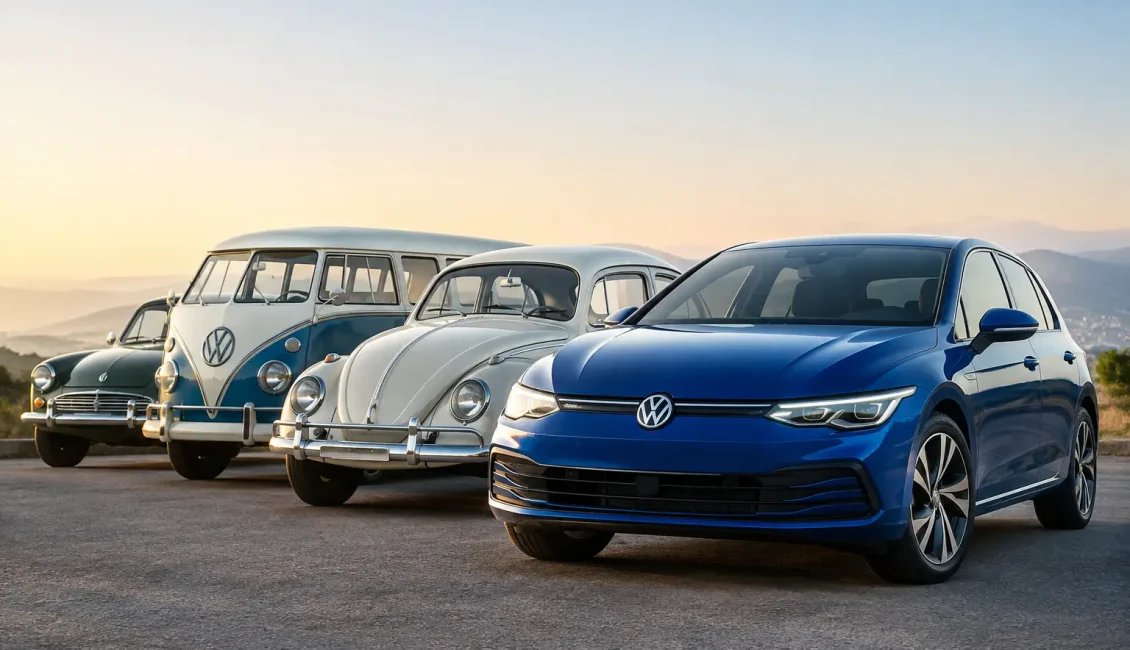
A split-screen Volkswagen display tells a story before the engine even turns over: one half is pure post-war optimism, the other a reminder that clever design can keep serving owners for generations. The history of VW is far bigger than the Beetle’s instantly recognisable silhouette. It takes in a politically troubling beginning, remarkable industrial recovery, family hatchbacks, hot-hatch heroes and some of the most familiar cars ever to grace British roads.
For enthusiasts, Volkswagen’s appeal has always been its range. A beautifully restored oval-window Beetle, a patinated Type 2 camper, a concours Mk1 Golf GTI and a modified modern Polo can all draw a crowd for different reasons. Few manufacturers have created such a strong connection between everyday motoring and genuine automotive culture.
The difficult beginnings of Volkswagen
Volkswagen was founded in Germany in 1937. Its name translates as “people’s car”, reflecting the ambition to build affordable motoring for ordinary families. The project was heavily tied to the Nazi regime, which used the proposed KdF-Wagen as propaganda for its leisure organisation, Kraft durch Freude, or Strength Through Joy. That context cannot be separated from the brand’s early story.
Ferdinand Porsche and his engineering team developed the basic layout: an air-cooled rear-mounted engine, simple mechanicals and a compact body designed to be economical to run. Production began at the new Wolfsburg factory, but civilian customers never received the cars they had paid into savings schemes for. With the outbreak of the Second World War, the factory turned to military production, including the Kübelwagen and Schwimmwagen, and relied on forced labour.
That origin is uncomfortable but essential history. Volkswagen’s later success was built on engineering that emerged during this period, while the human cost of the wartime factory must be acknowledged alongside the cars themselves.
From bombed factory to Beetle phenomenon
By 1945, Wolfsburg was badly damaged and its future looked uncertain. The British Army took control of the site in its occupation zone, and Major Ivan Hirst played a decisive role in getting production moving again. He recognised that the small car had potential, secured orders and helped establish the factory as a working concern rather than a dismantled industrial relic.
The car soon became known internationally as the Beetle, although Volkswagen did not initially use that name officially. Its virtues were straightforward: it was economical, mechanically uncomplicated and surprisingly durable. In a Europe rebuilding after war, those qualities mattered more than luxury.
Exports transformed the company. Volkswagen entered Britain in the early 1950s, and the Beetle gradually won over buyers who might once have viewed its unconventional looks with suspicion. Its rear engine, flat windscreen and distinctive exhaust note were unlike the British saloons of the day. Yet the Beetle’s reliability and character made it a fixture of driveways, holiday routes and, later, the classic-car scene.
The model’s success was extraordinary. More than 21 million Beetles were built worldwide before production finally ended in 2003. It became one of the best-selling cars in history, but its real achievement was emotional rather than numerical. Owners personalised them, raced them, rallied them and kept them going with a practical toolkit and a willingness to get involved.
The Transporter creates its own following
The Type 2, better known as the Volkswagen Transporter, arrived in 1950. It began as a humble commercial vehicle, capable of carrying people, tools or stock, but its flat-sided shape soon became an icon in its own right. Panel vans went to work, while Microbuses and camper conversions took families to the coast, festivals and campsites.
Early split-screen examples are now prized classics, particularly in original condition. Later bay-window and T25 models have their own loyal following, often because they offer more usable space and better road manners. As with any classic, the romantic appeal comes with a trade-off: corrosion, restoration costs and parts quality demand careful attention. A shiny camper is not automatically a sound one.
The history of VW turns towards the front wheels
By the late 1960s, Volkswagen had a serious problem. The Beetle remained popular, but its basic design was ageing and the company needed modern cars for a changing market. The answer came partly through the acquisition of Auto Union and NSU, bringing valuable engineering expertise and new product possibilities.
The 1970s produced the models that reshaped Volkswagen. The Passat arrived in 1973, followed by the compact Scirocco coupé and the practical Golf in 1974. Front-wheel drive, water-cooled engines and sharp, square-edged styling marked a decisive break from the Beetle era.
The Golf was the breakthrough. Designed by Giorgetto Giugiaro, it combined a compact footprint with a versatile hatchback body and sensible running costs. It was the right car at the right time, particularly after the oil crisis made thirsty, oversized vehicles less appealing. For Britain, it became a familiar sight everywhere from supermarket car parks to motorway slip roads.
Then came the car that turned sensible transport into a performance legend. In 1976, Volkswagen launched the Golf GTI. Its fuel-injected 1.6-litre engine, lowered suspension and discreet red grille surround created a new formula: everyday practicality with properly involving pace. The original GTI was not about shouting. It was about knowing exactly what you had.
That restrained attitude remains central to the GTI badge. Later generations grew larger, safer and more sophisticated, and purists will argue over which is best. The Mk1 has raw charm, the Mk2 feels wonderfully analogue, and newer cars deliver performance that early GTI owners could scarcely have imagined. Each offers a different kind of appeal.
Volkswagen culture reaches British roads
Volkswagen’s strength is that it inspires more than one type of enthusiast. Air-cooled owners value period detail, originality and the pleasure of keeping a simple machine alive. GTI fans chase factory-spec perfection, track-day upgrades or sympathetic modernisation. Transporter communities build entire weekends around camping, club stands and family-friendly meets.
In the modified scene, Volkswagens have also proved hugely adaptable. A Beetle can be a slammed show car, a historic racer or an off-road Baja build. Golfs have supported decades of tuning culture, from subtle period-correct wheels to serious turbocharged projects. The best builds still respect the base car’s purpose, whether that is a clean daily driver, a quick B-road machine or a vehicle made to stop visitors in their tracks.
This variety is exactly why Volkswagens remain such reliable crowd-pullers at live shows. Their owners tend to know the detail: correct bumpers, rare trim, original paint codes, engine swaps and the stories behind a long restoration. That conversation around the vehicle is part of the attraction.
New eras, familiar challenges
Volkswagen entered the 21st century as one of the world’s largest automotive groups. It expanded its model range dramatically, from city cars to luxury SUVs, while the Golf remained a core part of the line-up. The brand also revived familiar names, including the Beetle and Scirocco, though nostalgia alone could not guarantee lasting sales.
Its reputation suffered badly in 2015 with the diesel emissions scandal, a major corporate failure that affected trust in the company and raised wider questions about regulation, testing and manufacturer accountability. Volkswagen has since invested heavily in electrification, introducing its ID range as it tries to define another major chapter in mass-market motoring.
Whether the electric era creates classics with the same affection as an air-cooled Beetle or Mk2 GTI remains to be seen. Modern cars are more complex, quieter and packed with technology, which brings clear benefits but can make ownership feel less hands-on. Still, every generation finds its own heroes, and the cars that feel ordinary when new often become the ones people miss most.
At Great British Motor Shows, a Volkswagen stand can bring together decades of motoring in a few rows of cars. If you own one, bring the story with it: the first family holiday, the barn-find rescue, the careful restoration or the weekend spent refining a cherished build. Those details are what turn a familiar badge into a memorable show car.



 Image: CORGI
